
Using self-awareness not to define yourself—but to grow beyond what you thought was fixed
More Than a Label
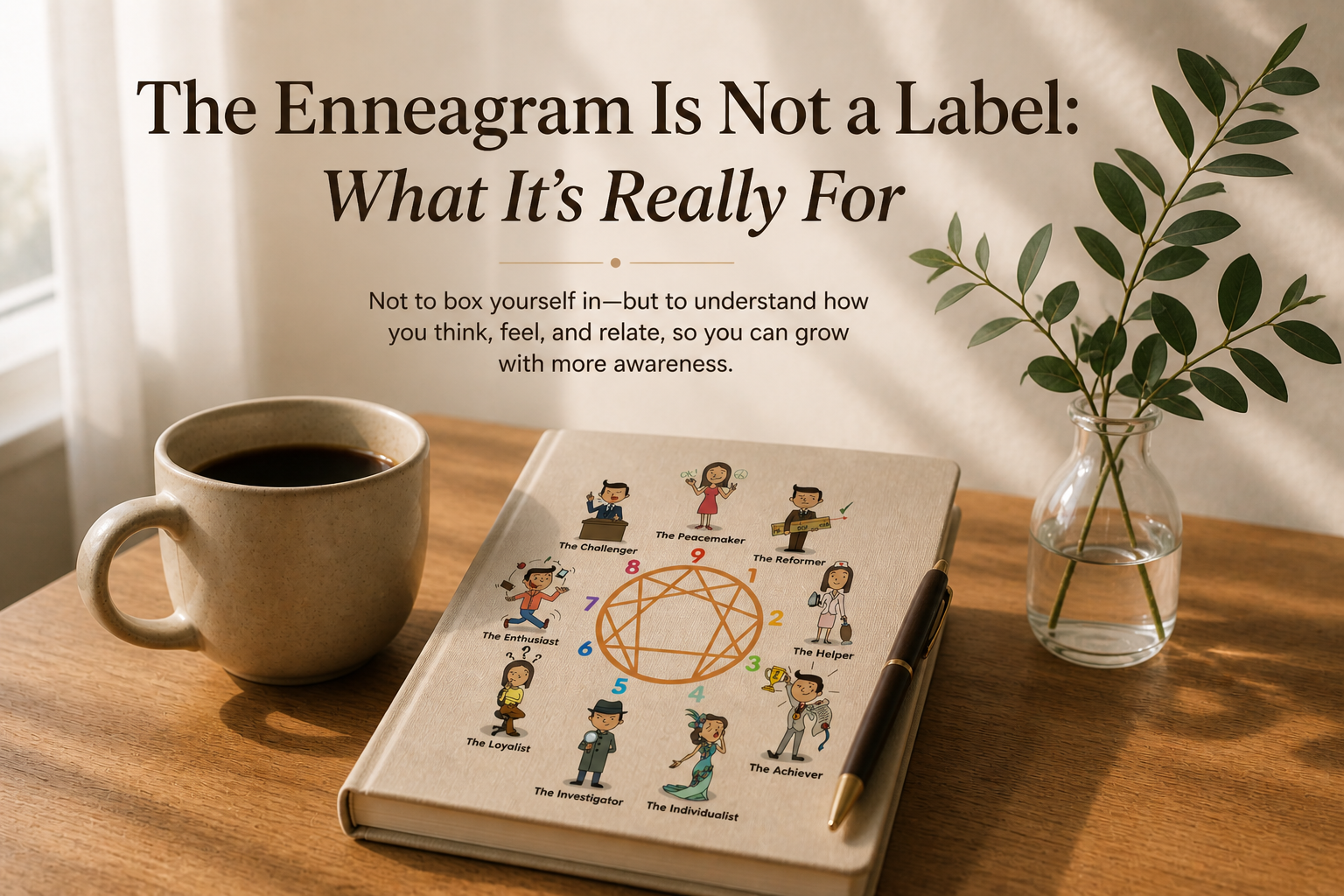
The Enneagram is often introduced as a personality typing system. Many people explore the Enneagram for personal growth, yet misunderstand its purpose. While it does describe patterns of thinking, feeling, and behaving, it was never meant to define who you are.
Some people become overly attached to their type—as if it explains everything about them. Others resist it entirely, afraid of being boxed in or labelled. Both reactions are understandable, but they miss the point.
The Enneagram is not here to separate you from others or place you into a fixed category. It is a tool for awareness. And awareness, when used well, creates choice—not limitation.
Understanding Patterns Without Becoming Them
Each Enneagram type reflects a set of tendencies—how you respond under stress, what motivates you, and what you may unconsciously avoid. These patterns are not your identity; they are habits developed over time.
The challenge begins when people mistake awareness for identity. Saying “this is just how I am” can quietly turn insight into a boundary. Instead of using the Enneagram to grow, it becomes something that keeps you the same.
True understanding does the opposite. It helps you recognise your patterns so that you are no longer controlled by them. When you can see your tendencies clearly, you gain the ability to respond differently.
Growth Happens Outside the Comfort of Your Type
Every personality type has its strengths—but also its blind spots. Growth begins when you are willing to step beyond what feels familiar.
If your pattern is to seek control, growth may look like learning to trust. If your pattern is to avoid conflict, growth may require honest expression. If your tendency is to seek approval, growth may mean standing firm in your own decisions.
The Enneagram gently points out these edges. Not to criticise you—but to show you where your next level of growth lies. It doesn’t ask you to become someone else. It invites you to become more balanced, more aware, and more intentional.
A Tool for Connection, Not Comparison
Another common misunderstanding is using the Enneagram to compare—who is better, stronger, or more “evolved.” This creates distance rather than connection.
When used well, the Enneagram deepens understanding between people. It helps you see that others are not difficult—they are simply operating from a different internal world. This awareness softens judgment and builds empathy.
It reminds you that everyone is navigating their own patterns, their own fears, and their own way of coping. And in that understanding, relationships become less about control and more about connection.
Becoming More of Who You Already Are
At its core, the Enneagram is not about becoming a different person. It is about becoming a freer version of yourself.
When you are no longer driven by unconscious patterns, you begin to act with more clarity. Your reactions become choices. Your habits become flexible. And your sense of self becomes less tied to fear and more grounded in awareness.
You are not your type. Your type is simply a starting point—a lens that helps you understand yourself better, so that you are no longer limited by what you once believed was fixed.
If you’ve explored the Enneagram before but felt unsure how to apply it meaningfully, you’re not alone.
Sometimes, it’s not about knowing your type—it’s about understanding what to do with it. And with the right guidance, that awareness can become something far more useful than just a label.